Showing posts with label crested gecko. Show all posts

Monday, 11 November 2013

Your New Crested Gecko - What You Will Need

I'm planning on doing a few posts today on getting a new crested gecko!
Seeing as my crested geckos are breeding, lots of family and friends are planning on having one/some of the babies. I think it's important that people know everything about crested geckos before they get them. They aren't exactly your average pet, and vets and pet stores don't tend to specialize in them.
Here's my first of a series of posts on new crested geckos. This post is about everything you will need before you go ahead and buy your crestie.

Vivariums


The most important thing you will need before you get your new gecko is his home! You can find vivariums in reptile stores and most likely any pet store that sells reptiles. Look around in different stores near you before you go ahead and buy one; you may find that some are cheaper than others. You might even want to look online, but I would recommend  buying a vivarium first-hand.

Crested geckos require a 'tall' vivarium, and the smallest you should consider getting should measure 12" by 12" by 18" (approx 12 US gallons). This should comfortably home one adult crested gecko, at the most two.
If you're planning on having 2 or 3 crested geckos, you might want to consider getting an 18" by 18" by 24". This is the size vivarium I currently own for Rocco and Savannah, my own crested geckos. It is approximately the size of my bedside table/chest of drawers, although slightly smaller, and they have far much more personal space in this sized enclosure than the 12" by 12" by 18".
Exo Terra is probably your best bet for a vivarium: their enclosures are safe, well-ventilated, beautiful and very trustworthy.


www.exo-terra.com
Exo Terra 'tall' vivariums; left: 12" by 12" by 18", right: 18" by 18" by 24"

Another reliable vivarium source is Komodo. Exo Terra is probably the better option: the vivariums have backings that create a natural environment, they are very well ventilated and are a much more largely used company. I feel that Exo Terra make far more attractive enclosures than Komodo, but others may disagree!
www.exotic-pets.co.uk
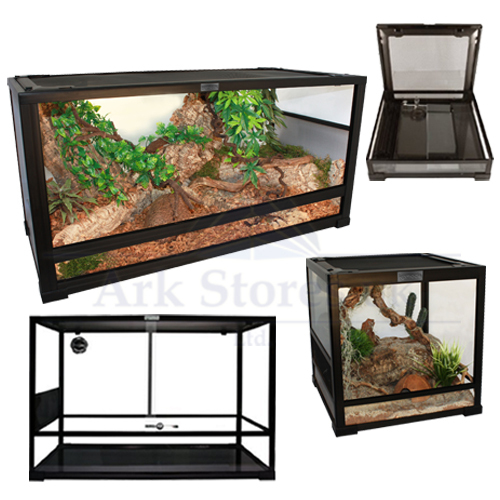
The above images are examples of Komodo vivariums you can find (not tall).

If you're considering getting a vivarium, you might want to go look at the different variety yourself and consider which you prefer. Some stores even sell wooden vivariums, although these don't tend to come in the 'tall' option and they are less popular for crested geckos. They tend to suit leopard geckos more. However, you may find that the wooden styled vivarium fits in better with your room.
www.animalinstinct.co.uk
An example of a tall wooden vivarium (less recommended).

I think wooden vivariums are beautiful, I really do, although I feel they are far less practical for cresties. If you are looking for beauty in your vivarium, I recommend you do as I have done and find a beautiful backing, a heat light and some pretty plants or flowers to decorate the inside. The light makes a whole lot of difference to the vivarium's appearance.

Inside Your Vivarium


Inside your vivarium you need to make it as natural as possible for your crestie(s).
Below is a list of everything I have inside my own vivarium:
  • One large Exo Terra hanging plant (Ficus, silk)
  • One small Exo Terra hanging plant (Abuliton, silk)
  • One large Exo Terra jungle vine
  • Two ground plants (one large-leaved alike scindapsus, one philodendron)
  • Two forest branches (one small, one large)
  • One piece of cork bark
  • One Buddha vivarium background
  • One medium Exo Terra water dish
  • Coconut fibre substrate
  • One Exo Terra dial thermometer
  • One Exo Terra dial hygrometer
This amount of items isn't necessary, but crested geckos do spend a lot of their time hiding. It is necessary to provide your gecko(s) with the amount of equipment they may need to hide sufficiently.
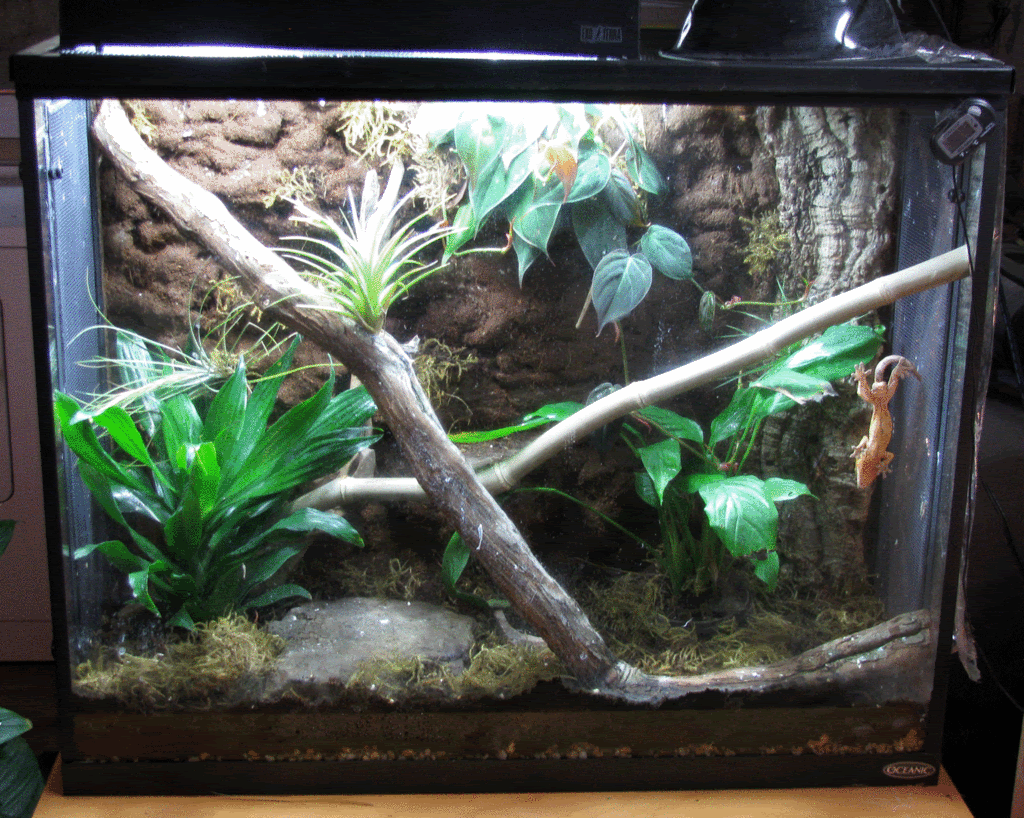
www.vivariumguide.com

The above image is an example of efficient hiding apparatus for your crested gecko.

Something also important for your crested gecko's enclosure is climbing equipment.
Those of you with crested geckos will know they get most of their exercise from climbing. With the help of the lamallae on their feet and tail tip, crested geckos spend most of their time vertically. They get most of their exercise from climbing, excluding when hunting, and even climb to the top of the vivarium so to climb on the wire mesh!
It's not necessary to include lots of climbing equipment as crested geckos can climb glass and most other surfaces, but it's probably a good idea to insert some obstacles so your gecko has some interesting routes and gets some decent exercise!
Jungle vines are the best kind of climbing apparatus, as they can be wrapped around other decor and bent, twisted and turned into any shape or route.

www.flickriver.com

Essential Internal Equipment:
  • Thermometer (dial or digital)
  • Hygrometer (dial or digital)
  • Water dish
These are the only 3 essentials for your vivarium. Obviously, it is essential that your crested gecko has climbing and hiding apparatus inside the enclosure, but what you choose is up to you and how much you want to kit it out. The above 3 in my opinion are absolute essentials to ensure your gecko has a healthy living environment.
(To find out more about temperature and humidity in a crested gecko's vivarium, you can read my previous post at the following address: How To Keep Your Crested Gecko Healthy)

Other Necessities


There are other necessities that you will require before purchasing your crested gecko.

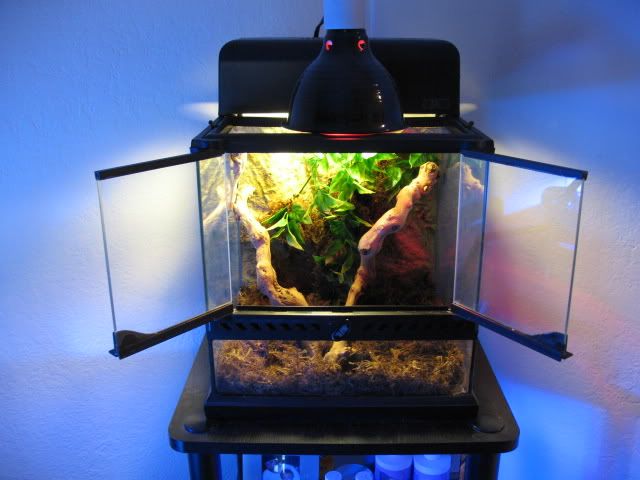
One of the most important requirements in this category is a form of temperature maintenance. This should be in the form of a heat mat or heat lamp.
Often you won't need to use your heat mat/lamp, and your crested gecko will be fine at room temperature. However, often at night times or in the winter, the general temperature can drop and leave the enclosure at low temperatures. Although it is important the temperature doesn't rise above 80F/26C, it's also important it doesn't drop below 50F/10C. Reptile specialists will inform you on which bulb or mat is suitable for your crested gecko.

www.ebay.co.uk
www.thescmas.com

As well as maintaining the temperature in your vivarium, it is just as important to maintain the humidity. This tends to be more difficult, and the natural humidity of your environment and the heat source you are using will affect how often you will need to top up the humidity.
It's easy to maintain once you know how quickly the humidity begins to drop in your environment. You simply need to purchase a 'mister bottle', which is a bottled pump that sprays a fine layer of water into the vivarium. Once you've done this a few times, you will establish how often you need to do so and how much you need to spray. Usually a heavy spray is required of an evening, and a light spray of a morning. It's easy enough once you've got the hang of it.

www.ebay.co.uk
Komodo water spray misting bottle!

The last thing you will need as an addition to your purchases is calcium and multivitamins. If you decide to feed your crested gecko on Crested Gecko Diet this is something you won't need to worry about, as all your gecko's requirements are already added to the mix. You will however need to buy these if you're considering feeding your gecko on live food, or fruit for a treat. You can purchase these in all reptile stores and most average pet stores, and more details on how to use these can be found in the link above in the 'Essential Internal Equipment' section.


I hope you enjoyed today's section, and I promise to post tomorrow or Wednesday with the next 'Your New Crested Gecko Segment': Buying Your Gecko.
Thank you for reading and for helping to make my blog a success. It means the world to me.

Regards,
Elly. x

Wednesday, 18 September 2013

Your Most Commonly Asked Questions Answered

There are some questions that I hear people ask constantly, whereas others are asked less often.
Here are the answers to the most commonly asked questions. If you have any other questions just add them to the comments below, and I will respond as quickly as possible! If your question is suitably relevant, interesting and worthy of the post I might even think about adding it to the entry. ;-) if you're lucky!

I hope that this post gives you the answers you've been searching for!


Why can't my crested gecko stick to the glass?

I had the same issue with Rocco recently.
The main reason for this is due to shed stuck to the bottom of a crested gecko's feet. Sometimes if a crestie has difficulty shedding, or any reptile, bits of shed can remain stuck to the body. This could be due to a lack of humidity, or if the reptile can't find any rough object to help with the shedding. It isn't usually an issue, and only large pieces of shed stuck to the body (which should be reasonably noticable!) should cause any major issues such as growth limitation.
www.digplanet.com
Crested geckos have 'sticky pads' on the bottoms of their feet called lamellae. These are hair-like structures that help your gecko to cling to smooth surfaces thus climb. If shed becomes stuck on the bottom of the feet, your gecko might have difficulty sticking to smooth surfaces. If you find that he has this problem, you can easily cure it by bathing him. It's pretty easy: just place your gecko in shallow, lukewarm water for a few seconds or so. This should rid of the shed. If the shed still doesn't come off, you can try removing it gently with a cotton ear bud.
If you find your gecko doesn't have shed stuck on his feet, then it is most likely due to too low humidity in the vivarium. This can be cured by purchasing a dial hygrometer to measure the humidity in the enclosure, and spraying more heavily and more frequently.

Why doesn't my crested gecko want to eat?

This is probably one of the most commonly asked questions I hear.
Crested geckos may not want to eat for many reasons and may often be put off their food. Some are more serious than others, and some are more temporary than others!
The main reason for a loss in appetite in cresties is stress. This is usually down to moving enclosures, being introduced to new people, being introduced to new geckos etc etc. The causes of the stress should be pretty obvious to you. It will almost definitely happen when you get a new gecko. The stress of travelling, being in a small enclosure during travelling, being introduced to a new home and to a new owner should stress your gecko out completely for a few days. You should not expect him to eat at this time.
Crested geckos may also be reluctant to eat if introduced to a new food. I often have this trouble with Rocco and Savannah, and they almost go into a 'sulking' mode for the first few feeds with the new food. After they've realised that the food is tasty and that they are being fed this food from now on, you shouldn't have any trouble.
www.aqualandpetplus.com
Your crested gecko might also not want to eat if they don't like their food. Rocco doesn't actually like Crested Gecko Diet, and he's very fussy about what he eats. Other than fruit, he is completely motivated by movement and won't eat something unless it's super wriggly! This could be the main issue for your crested gecko, too. You should try to find a food that is either really flavoursome, or moves around a lot! It will be good exercise for your gecko too.

Why doesn't my new crested gecko want to be handled?


When you first get your crested gecko, don't expect it to want to be held all the time. If it's a store-bred gecko, it's likely that it was rarely handled and is not used to human contact.
If your crestie is young, it is more likely he will be jumpy and flighty when handling. To avoid this, you should allow your crested gecko to get used to you before handling properly. Put your hand in the vivarium and allow him to get to know your smell. After a while he should climb onto your hand. If you continue doing this routine, handling inside the vivarium for a week or two, you should be okay to handle outside the vivarium. Just be careful with where you go if your crested gecko is still jumpy! You don't want to lose him.
You must also remember that a crested gecko isn't naturally man-handled in the wild. Especially at first, this is an unnatural and stressful experience for him! Don't expect him to settle right away.
www.reptileexpert.org
Even when you do handle your crested geckos properly, you mustn't over-handle them. Reptiles don't really enjoy handling overall, but they will tolerate it. This is the general rule, although there are cases where reptiles do appear to enjoy handling, and other cases where they will not tolerate it!

Why doesn't my crested gecko drink from the water bowl?


As the majority of you Crestie owners will know, crested geckos spend most of their time vertical. They hide away behind leaves in branches and plants and stick to the side of the vivarium. It's rare to actually see your crested gecko epromg the vivarium floor.
Because of this, unless desperate for food and/or water, you shouldn't often see your gecko drinking or eatin from a bowl on the vivaro floor. They may do so at night when you are asleep - crested geckos tend to be quite shy about eating in your presence.
www.redbubble.com
You will more likely see your gecko drink from falling water droplets. When you spray your vivarium of an evening, you should notice him fake a drink from the water droplets on the glass or branches. If you don't see this then don't worry! Your gecko won't die of thirst. A humid vivarium prevents dehydration.

Why is my crested gecko pale?


In humans, being pale is a sign of poor health. It is quite the opposite in crested geckos!
Crested geckos become pale just before they shed their skin. Shedding is a sign of good health! It means your Crestie is growing well. Crested geckos shed when their bodies require room to grow. Their skin is not elastic like ours and does not grow with them.
www.flickriver.com
If your crested gecko resembles the white/pale end of the gecko above, you do not need to panic! He/she is just due a shed and should shed that evening. They will be back to their bright and vibrant selves in the morning!

Why does my crested gecko not move in the day?


This answer is pretty obvious, and the question tends to make me chuckle! However, for those who don't know much about the crested gecko, you should probat know that they are nocturnal. In less scientific terms, they sleep during the day!
www.flickriver.com
It is not abnormal to find that your gecko is in the same place in the evening that you saw her in the morning. She's fine. She's not dead, ill or 'lazy'! She's simply sleeping, and you should try not to distin her until evening. She's probably comfortable!

Why is my crested gecko's tail twitching?


A crested gecko 'wagging its tail' is not a sign of pleasure like a dog. It doesn't mean your Crestie is happy; in fact, it is quite the opposite.
Your crested gecko wagging his tail is a sign of stress, and if you should see this happen you should b k AY immediately! It could be an indication of tail-dropping.
www.thegeckospot.net
For those of you who don't know, a crested gecko drops its tail in stressful situations. It does NOT grow back. This is not harmful or less an advantage to a crested gecko, but you do not want to risk infection or to put your gecko through such stressful and sinful situations. Us, their tails are beautifn

Why is my crested gecko opening his mouth?

You have to be careful not to mistake the opening of the mouth for licking of the eyes or face. Crested geckos regularly lick their eyes to provide moisture, due to the fact they have no eyelids. Occasionally it can appear that your crestie is opening his mouth up, although really he is just licking his eyes.
However, if you do observe that your crested gecko is opening his mouth and is not licking his eyes, you should try to avoid handling him immediately, or stop whatever you're doing that could be stressing him out. The opening of the mouth is a sign of stress, which could in turn lead to lack of appetite, aggression towards the owner (although this is rare) and most commonly, as previously mentioned, tail-dropping!
www.pangeareptile.com
The above image is a pretty inaccurate representation of a crested gecko opening his mouth, because it is a pretty extreme case of this! The likelihood is that this crestie was acting aggressively at the time or was encouraged to open his mouth (possibly in the event of checking the calcium sacs).
Your crested gecko doesn't have to open his mouth this wide, or for long, to show signs of stress. You should always keep an eye out for it if possible.

Why is my crested gecko cold?

Crested geckos are reptiles, and therefore they are cold-blooded. This means that their body temperature varies with their surroundings. Humans and other mammals are warm-blooded, and no matter the temperature of our surroundings we generally stay around 37 Celsius. A crested gecko's body will not respond to a temperature change, and the body temperature of a cold-blooded animal will increase or decrease as does the temperature of the surroundings.
coolcosmos.ipac.caltech.edu
Generally your crested gecko should feel a little bit cool. Cold is not really a healthy sign and might signify that your vivarium is too cool for your gecko. Otherwise, cool is good! Our body temperature is around 37 Celsius, and an ideal temperature for a vivarium is 21. Your gecko should be roughly the same temperature as the inside of the vivarium, so feeling slightly colder than yourself is probably a good sign.


Can I feed my crested gecko baby food?

This question continuously comes up, and it raises so much controversy and debate. People get so angry and heated over this topic of conversation, and really there is no true answer! I think it's mainly down to matter of opinion, but I can guarantee you, without a shadow of a doubt, that the occasional feed of baby food is not harmful.
You should never, I must admit, feed baby food or any form of fruit puree as your crested gecko's staple food. Feeding once a week/fortnight alongside a nutritious staple food such as gut-loaded/dusted crickets and/or Crested Gecko Diet is fine. In the wild, cresties come across and feed on fruit. It has a sweet taste that they enjoy, and is generally more attractive than the taste of CGD or live food! You will even find that Crested Gecko Diet is mixed with fruit flavour to attract crested geckos.
There are many issues raised with baby food. Does it really have any nutritional value whatsoever? The truth is, not really, although it may have some. It contains vitamins and minerals and natural sugars, which are always a good thing, but not much more than that. Mixing the fruit with multivitamin supplements and/or Calci Dust could raise the nutritional value of the fruit.
You should really think about baby food like cake. Cake is delicious, but to feed on it everyday wouldn't be good for you. However, every now and then along with a healthy and balanced basic diet will not harm you, and at most will make you feel happy and motivated.
So, to answer the question, yes you can feed your crested gecko on baby food. No it won't kill him, so long as you don't feed it to him everyday!

Why is my crested gecko sleeping upside-down?

This is a question I can't really answer.
Why your crestie is sleeping upside-down I don't really know, but I find my own cresites, particularly Rocco, doing it sometimes. I think it's just a comfortable position for them, and they happened to settle down this way. It doesn't necessarily mean anything.
However, it is important that you try not to let your crested gecko sleep upside-down. There's something called Floppy Tail Syndrome that I've mentioned in a previous post, commonly known as FTS. This is when the crested gecko's tail falls across the body for a long period of time, causing the tail to permanently fall backwards or in a sideways position across the body of the gecko.
www.jbscresties.com
Floppy Tail Syndrome is not necessarily harmful or painful for your gecko. It's not a health risk and you shouldn't worry that he is in pain or suffering from his choice of sleeping positions! It's purely cosmetic, although is something that should be avoided if possible. No one wants a wonky limb, so why let your gecko get a wonky tail!
If you do happen to find your crested gecko sleeping upside-down, simply scoop him up and place him horizontally or upright.

Why is my crested gecko licking his eyes?

This is something I actually explained fully in an above answer, but this is something some people are grossed out by or are interested in.
Crested geckos don't have any eyelids. As humans we have a blinking reflex that allows our eyelids to close, providing moisture to our eyes. The eyes secrete lubricants and tears through the tear duct that moistens the conjunctiva and the cornea (the outer layers of the eye). Blinking stops the eye from drying out and helps to protect it from irritants.
As crested geckos don't have eyelids, they're unable to blink. In stead of blinking, to help keep the eyes moistened and free from dirt and irritants, they will reach their long tongue around their mouth until it reaches their eyes. They will usually take about 3 licks around the facial area before reaching their eyes.
www.talkphotography.co.uk
If the whole eye-licking experience creeps you out, it's probably best that you don't purchase a crested gecko. It's something they do pretty often, almost as often as... Well, blinking!

Can I keep more than one crested gecko together?

Yes, sometimes.
The answer to this depends on the gender of the geckos you're planning to keep and the size of the vivarium you have to offer. It also really depends on the temperament of your original gecko, if you already have one.
Two females are always okay to keep together. There should never really be any fighting between two females, as there is no need to express any dominance. So long as you try to avoid competition in the enclosure, e.g. there is enough food and space, then you shouldn't have any issues and they should appreciate the same-species company.
www.freewebs.com
Two males can never really be kept together. There have been few successful cases of this where all competition has been avoided and the males have gotten along okay, but you should really try to avoid this mix if you can, unless accidental due to incorrect sexing. Males will try to assert dominance and will fight - until the death. One will end up dead, if not seriously injured, if kept together for a long period of time.
A male and a female can be kept together, so long as you're prepared for breeding. You can keep a male with up to approximately 4 females. You shouldn't find the females fighting over the male, as it is usually the male that initiates copulation. You should never keep more than one male together with females, as they will definitely fight over the female(s) that they wish to mate with. Only be prepared to keep opposite genders together if you can provide an enclosure for the male at the end of the meeting season, and an enclosure for the hatchlings until they are ready to be sold. You should also have somewhere safe where you can incubate the eggs.

Why is my crested gecko changing colour?

Crested geckos change colour according to their stress levels, the amount of light, the time of day and humidity. You will find that if the room is bright, they are more stressed/active than usual and/or they are in a humid environment/the surface of their scales is wet, they should be 'fired up'.
'Fired up' is the term used to describe the more vibrant morph of your crested gecko. They should have 2 main colour schemes: fired up and fired down. One should be a more vibrant shade of the other.
If you see your crested gecko is a different colour, don't worry! He hasn't spontaneously reproduced overnight, and you didn't accidentally purchase a chameleon!
www.reptilesthatdontsuck.com
This is quite an extreme case of firing up, and the colour shouldn't usually change as much as in the image above! However, it should give you an idea of the difference between fired up and down.

Can I keep my crested gecko in my pocket?

I've known various people that have done this, claiming they enjoy to be close and that it makes them feel safe in the dark, tight spaces.
Well, the answer to this question is simply no. You should never put your crested gecko, or any pet for that matter, in your pocket. You should never really have your crested gecko out for more than 15 minutes as you want to encourage natural behaviour and don't want to cause unnecessary stress. You should also not risk suffocation, tail-loss, high stress levels or harming your gecko in any way. Your gecko probably does not like to be kept in your pocket at all, so please don't.

Can I let my crested gecko roam free in my house?

I've also known various people that have done this, and I would truly recommend against it. I don't think you could go to any reptile specialist and find that they'd recommend it.
Your crested gecko will struggle to hunt for food; he won't like the open spaces and unnatural environment; they will probably become aggressive and unfriendly; there are many health hazards such as electrocution, crawling into small spaces, suffocation and being squished; you might accidentally hurt your crested gecko and you will probably never see him to check on his health! There is also a huge risk of escaping, and it is unlikely that your crested gecko would be able to survive the outside world for more than a couple of days. Please people, whatever you do, keep your crested gecko in a vivarium! He will live a much happier, healthier life.


For the moment, this is the end of my question-answer session!
If you have any queries/questions, comments, ideas or advice, please feel free to comment in the section below. Alternatively, you can contact me through the following address:
elly_crook@icloud.com
This is the email address I will be primarily using from now on, although I will be checking my other email addresses regularly if you'd prefer to use those/have those stored.

Thank you very much for reading and I hope that my answers and my advice could help you today with any questions that you might have!
Elly. x


Saturday, 31 August 2013

Savannah's 'bed'!

Hi guys!
A less serious/business post now - an update on the adorable couple!

Rocco and Savannah have been doing brilliantly recently.
They've been eating very well, hunting on their own, and Savannah has shed since the last time I updated you. She's grown so much! Rocco we think is due a shed tonight, as his skin feels rough and baggy and he's a very pale white.

There's so many videos and pictures I'm desperate to show you, so I'm going to show them to you in sections.

Savannah's Bed


The geckos took a few days to find their way around the vivarium and discover the new attractions that awaited them. Now they're comfortable in their surroundings, they've once again found their favourite places in the vivarium.
Every single day when I go into the vivarium, I always struggle finding Rocco and I will find him hidden in different places. Savannah, however, I can guarantee will be in the same place. We now have a nickname for it, and call it her bed.

She found a pretty stand-up flower on the left of the vivarium I'd put there, which has two large cupped leaves. She'd climbed into the pouch, as she's so little, and hidden deep down in it towards the center of the flower. I can find her there every single day, all day.

I found one day that Rocco had joined Savannah! 

Look at them snuggled in their own little pouches. 

You can just see their little noses poking out from the front of the plant! What a brilliant hiding place. Kudos to Savannah! 

One day, I even found them upside-down! So funny! 


Here's Rocco's amazing hiding place. Haha! I always told you he was rubbish at hiding.
He looks so cool and streamlined! It's like he's about to dive. 


Here's a wet Savannah tucked in her pouch after a misting.

Drinking

The other thing I really want to show you is the videos and pictures of Rocco and Savannah drinking.
They've really got into drinking water droplets after a misting recently. I don't know if the larger vivarium gives them more things to drink the water from, and now they can climb the glass easier it is probably a lot easier for them to drink from it. They have been drinking water droplets off of the glass, leaves, wood and plants!
It's absolutely adorable, and everytime I spray they are super eager for a drink, so I try to spray them and their surroundings directly. They always end up super covered in water droplets, yet for some reason they love it. It's like watching a pig in the mud.
Maybe I should make them a little paddling pool...

These pictures are truly awesome.
I'm not going to caption them, but seriously enjoy them. They're amazing.


Ah, got some really good pictures of Rocco this morning! They are SO sweet.
I hope you really enjoyed these pictures and videos - they are amazing. You can't get much better than that, other than an action jumping shot! They're difficult to snap.

Thanks again for reading!
Elly. x